Module 10: Actinic Keratosis
1. Learning Objectives
After completing this module, the learner should be able to:
- Define actinic keratosis (AK) and explain its classification as a spectrum of keratinocytic atypia ranging from grade I to grade III.
- Identify the hallmark dermoscopic "strawberry pattern" of AK, composed of the pink-red pseudonetwork combined with follicular plugs with halo (FPWH).
- Recognize and differentiate the key nonvascular dermoscopic features of AK: follicular plugs with halo (FPWH), rosettes (under polarized light), scales, crusts, and structureless areas.
- Recognize and differentiate the key vascular dermoscopic features of AK: pink-red pseudonetwork, linear wavy vessels, dotted vessels, and hairpin vessels with white halo.
- Describe the dermoscopic features of pigmented AK and apply criteria to distinguish pigmented AK from lentigo maligna (LM) and lichen planus-like keratosis (LPLK).
- Apply the dermoscopic grading system for AK (grades I through III) and correlate dermoscopic findings with histologic severity.
- Identify dermoscopic clues that suggest progression from AK toward squamous cell carcinoma (SCC) in situ.
- Integrate clinical context (surface palpation, actinic damage background, patient history) with dermoscopic findings to reach an accurate diagnosis.
2. Prerequisites
- Module 01: Introduction and Principles of Dermoscopy -- understanding of polarized vs. nonpolarized dermoscopy, equipment, and image capture is essential (rosettes are only visible under polarized light).
- Module 02: Histopathologic Correlations of Dermoscopic Structures -- understanding of how dermal/epidermal structures produce dermoscopic patterns, including vascular correlates, keratinizing tumor correlates, and the concept of pseudonetwork on the face.
3. Key Concepts
3.1 AK as a Precursor Lesion
Actinic keratoses are cutaneous lesions containing some degree of keratinocytic atypia induced by chronic ultraviolet (UV) radiation exposure. They occupy a biological spectrum:
- Grade I AK: Minimal keratinocytic atypia confined to the lower part of the epidermis.
- Grade II AK: Atypia extending through the lower to middle epidermis.
- Grade III AK: Full-thickness epidermal atypia. When minimal, this is classified as grade III AK; when marked, it is reclassified as squamous cell carcinoma in situ (Bowen disease).
Because of this continuum, dermoscopic features of grade III AK and SCC in situ overlap substantially, and it may not be clinically or dermoscopically possible to differentiate them from each other.
3.2 Field Cancerization
AK rarely occurs in isolation. It arises within fields of chronically sun-damaged skin ("field cancerization"), where subclinical keratinocytic atypia extends beyond visible lesions. This concept is critical because:
- The background actinic damage creates a pseudonetwork pattern across the entire field.
- Multiple AKs may be present within a single field.
- Rosettes and follicular changes on surrounding skin reflect subclinical damage.
- Treatment strategies (field-directed vs. lesion-directed) depend on recognizing the extent of field involvement.
3.3 The Collision Concept: Pigmented AK
Pigmented AKs arise from the collision of an AK with a solar lentigo. The resulting lesion combines features of both entities and can mimic lentigo maligna (LM), making careful dermoscopic evaluation essential.
4. Core Content
4.1 Clinical Context and Epidemiology
Actinic keratoses are among the most common dermatologic lesions, arising predominantly on chronically sun-exposed skin in fair-skinned individuals. They present as rough, scaly macules or thin plaques on sun-damaged skin of the face, scalp, ears, dorsal hands, and forearms. Clinical diagnosis relies on the combination of:
- Visual appearance: Erythematous, scaly patches on a background of photodamaged skin.
- Tactile clue: AKs have a characteristically rough, sandpaper-like texture that is often easier to feel than to see. This rough surface is a key clinical differentiator from lentigo maligna, which has a smooth surface.
- Context: Background actinic damage including solar lentigines, telangiectasias, and skin atrophy.
4.2 Classic Dermoscopic Features of AK
The literature identifies a set of classic AK features: pink-red pseudonetwork, follicular plugs surrounded with a white halo, linear wavy vessels, dotted vessels, and conspicuous scales. The first three signs are frequent in AK grades I and II, whereas dotted vessels and scales are more prominent features of AK grade III and SCC in situ.
Check Your Understanding
What is the 'strawberry pattern' in dermoscopy, and which lesion is it associated with?
The strawberry pattern is associated with facial actinic keratosis. It consists of a pink-red pseudo-network (erythematous background interrupted by follicular openings) with prominent yellowish keratotic plugs filling the hair follicle openings, resembling the surface of a strawberry.
4.3 Nonvascular Features
4.3.1 Follicular Plugs with Halo (FPWH)
Synonyms: Targetoid hair follicles; hair follicles with an inner gray halo.
Description: Multiple follicular plugs containing keratin are usually readily visible on dermoscopy. As keratin builds up within the ostial opening, it causes the orifice of the follicle to widen. The follicular epithelium surrounding the central keratin plug corresponds to the "halo" seen on dermoscopy.
Clinical significance: FPWH is the cardinal dermoscopic sign that helps identify AKs and differentiate them from lentigo maligna (LM). The constellation of FPWH surrounded by erythema, resulting in the appearance of a pink-red pseudonetwork, creates the hallmark "strawberry pattern."
Skin type variation: In darker skin, FPWH can be hyperpigmented and thus appear delineated by a dark rim rather than the typical lighter halo.
Differential considerations: Other conditions also exhibit follicular plugs, including:
- Discoid lupus erythematosus
- Keratosis pilaris
- Viral-associated trichodysplasia
However, the clinical context -- particularly the presence of background actinic-damaged skin -- usually allows differentiation from these entities.
4.3.2 Rosettes
Description: Rosettes are only visible with polarized light dermoscopy. They appear as four points of light arranged in a pattern creating the shape of a diamond or four-leaf clover.
Histopathologic correlate: Rosettes correspond to the keratin-filled follicular opening and result from the interaction of polarized light with the keratin within the ostial opening (FPWH).
Diagnostic value: While rosettes can be seen in background actinic-damaged skin and other skin tumors (including melanoma), their presence in a rough macule located on actinic-damaged skin is highly suggestive of AK, especially when multiple rosettes are located within the lesion.
Key point: Rosettes represent the polarized-light counterpart of the FPWH seen in nonpolarized dermoscopy.
4.3.3 Scales, Crusts, and Structureless Areas
Scales: The presence of scale contributes to the characteristic rough texture of AK and is a common feature observable in almost all AKs. In pigmented AK, the scale can take on the appearance of angulated lines -- a feature also associated with LM. However, the lack of other LM-specific features and the presence of a rough texture with FPWH help confirm the diagnosis of AK.
Crusts: The continued accumulation of adherent scale eventually results in the formation of crusts. The presence of crusts is a frequent feature of grade III AKs (hypertrophic AK) and SCCs.
Structureless areas: Large areas covered by scale-crust that obscure the ability to see follicular openings or any structures within the epidermis are termed structureless areas. Their presence is a marker of more advanced disease.
Key Takeaways
- The strawberry pattern (pseudonetwork of red with white-yellow scale filling follicular openings) is the hallmark dermoscopic pattern of facial AK.
- Follicular openings filled with keratotic plugs (FPWH -- follicular plugs with halos) are characteristic of early AK and help distinguish it from lentigo maligna.
- Rosettes (four white dots in a clover pattern under polarized light) are common in actinic field damage and AK but are not specific to AK alone.
4.4 Vascular Features
4.4.1 Pink-Red Pseudonetwork
Mechanism: Dilatation of capillaries increases blood flow in AK and results in their pink-to-red color. The erythematous skin of an AK is interrupted by dilated follicular openings, creating the so-called red pseudonetwork pattern.
The strawberry pattern: When this red pseudonetwork is combined with FPWH, it yields the hallmark strawberry pattern. This pattern is a strong indicator of AK/SCC.
Differential from melanoma: Melanoma can manifest pink-red color mimicking pink-red pseudonetwork, but this will not be associated with the characteristic changes of the hair follicle (FPWH). Hence, the strawberry pattern specifically requires the presence of FPWH within the pseudonetwork.
4.4.2 Linear Wavy Vessels
Description: Thin, linear, wavy vessels may be observed in all grades of AK.
Specificity: They are not specific and can be observed in many other lesions, both benign and malignant:
- Benign: Essential telangiectasia, cutaneous sarcoidosis
- Malignant: BCC and melanoma
4.4.3 Dotted Vessels
Description: Small red dots that are more readily visible under polarized light dermoscopy.
Distribution: Dotted vessels are frequently observed in AKs and Bowen disease.
Specificity: They are not specific and are commonly seen in inflammatory diseases, stasis dermatitis, and traumatized skin; they can also be present in neoplastic lesions such as melanoma.
Grade association: Dotted vessels are more prominent in higher-grade AKs (grade III) and SCC in situ.
4.4.4 Hairpin Vessels with White Halo
Description: While characteristic of keratinized tumors in general, hairpin vessels are rarely observed in hypertrophic AKs. They are more commonly seen in well-differentiated SCCs and seborrheic keratoses.
Significance: Their presence suggests a more advanced keratinizing process and should prompt consideration of SCC.
Check Your Understanding
How do you distinguish an actinic keratosis from an early lentigo maligna on the face using dermoscopy?
Actinic keratosis shows a strawberry pattern (red pseudonetwork with follicular plugs) and surface scale. Lentigo maligna shows asymmetric pigmented follicular openings, annular-granular pattern (gray dots around follicles), and rhomboidal structures. The key distinguishing feature is the pigmented versus non-pigmented nature of the follicular involvement.
4.5 Facial AK Patterns on Sun-Damaged Skin
AKs occur predominantly on facial skin, where the normal dermoscopic pattern is the pseudonetwork (created by follicular openings interrupting pigment and vasculature). Key considerations for facial AK include:
- The pseudonetwork of the face is the baseline pattern upon which AK features are superimposed.
- The strawberry pattern is the combination of this facial pseudonetwork with FPWH -- the follicular openings become enlarged and keratin-filled, surrounded by a halo, against a background of erythema.
- Background actinic damage produces rosettes and subtle follicular changes in surrounding skin that provide clinical context supporting the AK diagnosis.
- The inner gray halo around follicular openings is particularly relevant on the face, where it helps differentiate pigmented AK from LM.
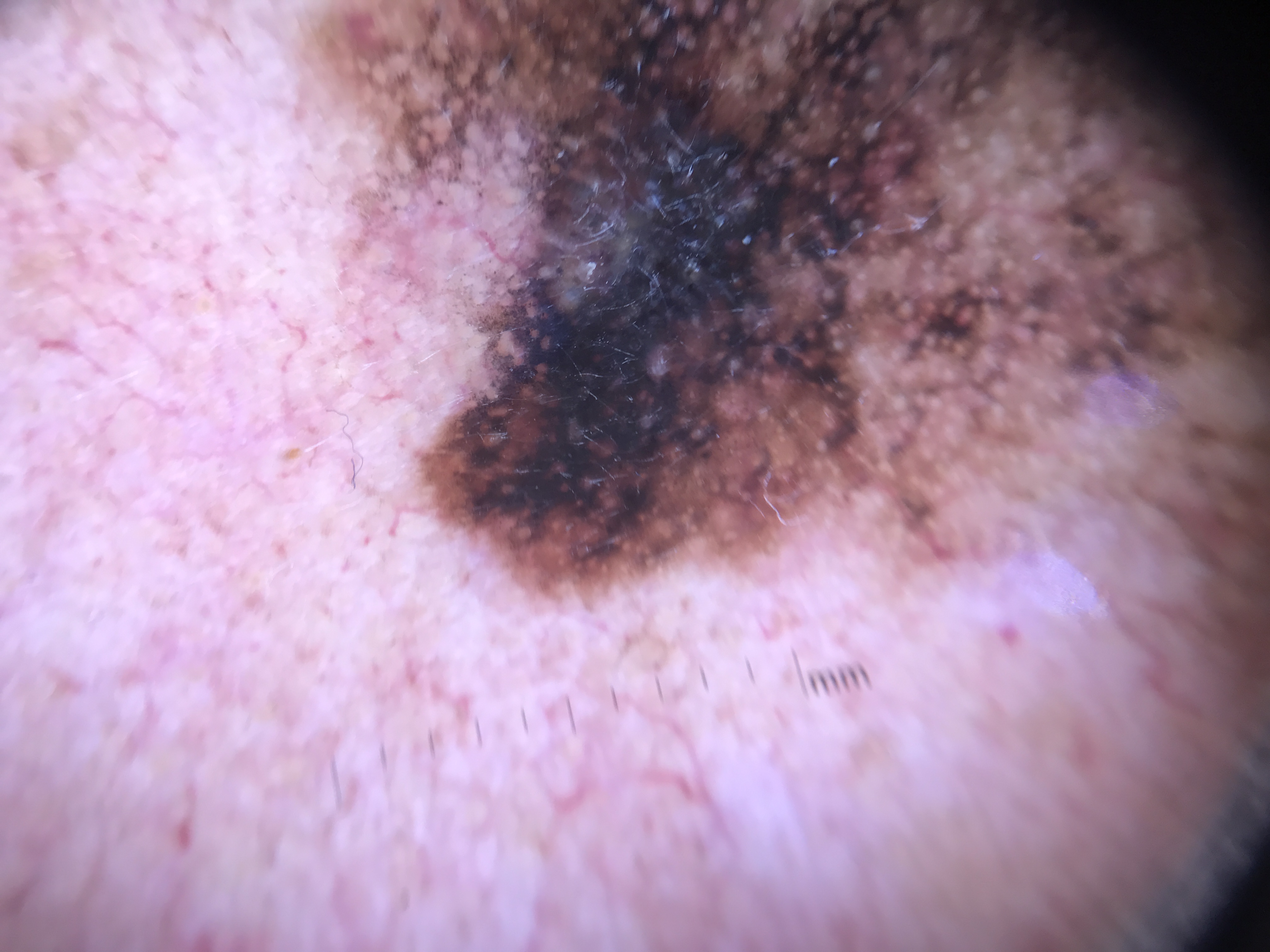
Clinical Scenario
A 69-year-old man with extensive sun damage presents with a rough-textured, erythematous macule on the forehead. Dermoscopy reveals a reddish pseudonetwork with prominent follicular openings that are enlarged, filled with yellow-white keratin plugs, and surrounded by a whitish halo (FPWH). Under polarized light, multiple four-dot white structures (rosettes) are visible scattered across the lesion. The surface is rough to palpation.
What is your diagnosis and key dermoscopic findings?
Actinic keratosis (Grade II -- strawberry pattern)
The classic strawberry pattern of AK is formed by the combination of FPWH (follicular plugs with white halos) on a background of erythematous pseudonetwork. The enlarged follicular openings filled with keratin correspond to localized increases in cutaneous vasculature surrounding dilated adnexal openings. The rosettes under polarized light (four perpendicular white dots) correspond to hyperkeratosis of the follicular opening and are common in actinically damaged skin and AK. The rough texture is the key clinical clue distinguishing AK from lentigo maligna (which has a smooth surface). This is a Grade II AK based on the prominent FPWH pattern.
4.6 Pigmented AK
Origin
Pigmented AKs (pAK) arise from a collision of an AK with a solar lentigo. These pigmented AKs can sometimes be mistaken for lentigo maligna.
Dermoscopic Features of Pigmented AK
Pigmented follicular plugs with halo: The FPWH in pigmented AK creates dilation of the hair follicle diameter. The pigmentation around these dilated hair follicles appears as a pigmentation ring that has a much larger diameter than the diameter observed in solar lentigo, LPLK, or LM.
Inner gray halo: In pigmented AKs, a subtle homogeneous gray or beige halo surrounds follicular openings (or follicular plugs), forming a sort of "internal ring" to the brown meshes of the pseudonetwork. This is a frequently observed and diagnostically useful feature.
Angulated lines from scale: The scale in pigmented AK can take on the appearance of angulated lines, which is also a feature of LM. However, the rough texture and presence of FPWH help distinguish AK.
Constellation approach (global pattern): While LM may reveal any of the aforementioned AK features, these features will only be present focally within the melanoma, and the rest of the lesion will almost always reveal LM-specific features. In contrast, AK will have a rough texture across the entire surface, and the entire surface area of the lesion will reveal AK features such as FPWH and rosettes.
4.7 AK Grading by Dermoscopy
The dermoscopic grading system for AK correlates with histologic severity:
Grade I AK (Early/Mild)
- Rough-textured macule
- Red pseudonetwork (background erythema interrupted by follicular openings)
- Follicular changes may be subtle
- Wavy vessels may be present
Grade II AK (Moderate)
- Prominent FPWH creating the classic strawberry pattern
- Scale may be present
- Wavy vessels
- Rosettes (under polarized light)
Grade III AK (Advanced/Hypertrophic)
- Prominent adherent scale-crust
- Structureless areas (scale-crust obscuring underlying structures)
- Dotted vessels (more prominent at this grade)
- Hairpin vessels with white halo may appear
- May be indistinguishable from SCC in situ
Key Takeaways
- AK vessels include dotted vessels, hairpin vessels, and wavy (serpentine) vessels; their density and pattern help grade AK severity.
- Pigmented AK must be distinguished from lentigo maligna: AK preserves follicular openings and shows yellow-white scale, while LM shows gray dots around obliterated follicles.
- Dermoscopic grading correlates with histologic severity: Grade I shows subtle scale with preserved surface texture, Grade III shows thick hyperkeratosis obscuring underlying structures.
4.8 Progression from AK to SCC: Dermoscopic Clues
AK exists on a continuum with SCC in situ and invasive SCC. The literature illustrates this progression through a single lesion monitored over time showing an AK transitioning to a well-differentiated SCC in situ, demonstrating the overlapping features observed in AKs and SCCs.
Dermoscopic clues suggesting progression include:
| Feature | AK (early) | Progressing toward SCC |
|---|---|---|
| Scale | Fine, superficial | Thick, adherent crusting |
| Follicular openings | Visible FPWH | Obscured by scale-crust (structureless areas) |
| Vessels | Linear wavy | Dotted vessels become prominent |
| Hairpin vessels | Absent or rare | May appear (with white halo) |
| Surface texture | Rough macule | Thickened, hypertrophic plaque |
| Structureless areas | Absent or minimal | Extensive |
Key principle: Grade III AK lesions displaying full-thickness atypia are classified further by the amount of atypia -- minimal atypia represents grade III AK, while marked atypia represents SCC in situ (Bowen disease). The dermoscopic overlap is inherent to this biological continuum.
Clinical Scenario
A 73-year-old woman presents with a pigmented macule on the left cheek. Dermoscopy reveals pigmented follicular plugs with halos that are large in diameter, an inner gray halo around several follicular openings, and faint angulated lines. The surface is rough to palpation. Numerous rosettes are visible under polarized light. All features appear evenly distributed across the entire lesion surface. The surrounding skin shows diffuse actinic damage.
What is your diagnosis and key dermoscopic findings?
Pigmented actinic keratosis (not lentigo maligna)
The key differentiating features from lentigo maligna include: (1) rough texture across the entire surface (LM is smooth), (2) FPWH with large-diameter pigmented rings around dilated hair follicles (larger than those seen in LM), (3) the inner gray halo around follicular openings (a feature of pigmented AK, distinct from the asymmetric gray circles of LM), (4) numerous rosettes (common in AK, few to none in LM), and (5) uniform distribution of AK features across the entire lesion (in LM, AK-like features would be focal with LM-specific features elsewhere). The constellation approach confirms AK: the entire surface area reveals AK features (FPWH, rough texture, rosettes) rather than the focal, asymmetric features characteristic of melanoma.
4.9 Differentiation from Lentigo Maligna (LM)
Distinguishing pigmented AK from LM is one of the most clinically important differentials in facial dermoscopy.
Tactile Clue
- LM: Smooth surface on palpation.
- AK: Rough surface on palpation. This is a critical and easily assessed clinical differentiator.
Follicular Opening Size
- LM: Follicular openings appear smaller as melanocytes migrate along them.
- LPLK: Melanin deposits occur between follicular openings that are normal in size.
- Pigmented AK: The follicular plugs and halo correspond to an enlargement of the follicular size over the interfollicular epidermis, making the follicular openings appear largest on dermoscopy.
Constellation of Features (Global Pattern)
- LM: AK-like features, if present at all, appear only focally; the rest of the lesion reveals LM-specific features (asymmetric pigmented follicular openings, annular-granular structures, rhomboidal structures, obliterated follicles).
- AK: AK features (FPWH, rosettes, rough texture) are present across the entire surface area of the lesion. The constellation of AK features combined with the absence of clear signs of melanoma is the key to diagnosis.
Strawberry Pattern
- AK: The strawberry pattern (red pseudonetwork + FPWH) is a strong indicator. Melanoma can manifest pink-red color mimicking the pseudonetwork, but this will not be associated with FPWH.
- LM: Scale and crust may occasionally be focal, but will not encompass the entire surface and will not become as hyperkeratotic as in AK.
Inner Gray Halo
- Pigmented AK: A subtle homogeneous gray or beige halo surrounds follicular openings, forming an "internal ring" to the brown meshes of the pseudonetwork.
- LM: This feature is not typically seen; instead, asymmetric pigmentation around follicular openings is characteristic.
Pigmentation Quality
- Pigmented AK/SCC: Tends toward a "dirty gray" appearance with accompanying epidermal architectural atypia that is always present.
- Melanoma: Brown pigmentation that may vary to grayish coloration, but without the epidermal disruption characteristic of AK/SCC (though aggressive melanomas may show epidermal disruption).
4.10 Differentiation from Other Keratoses
AK vs. Seborrheic Keratosis (SK)
- SK: Comedo-like openings, milia-like cysts, fissures and ridges, hairpin vessels (well-formed), "stuck-on" appearance, sharp demarcation.
- AK: FPWH, rosettes, strawberry pattern, ill-defined borders, background of actinic damage, rough texture. Hairpin vessels in AK are rare and suggest progression toward SCC.
AK vs. LPLK
- LPLK: Follicular openings are normal in size, with melanin deposits occurring between them.
- AK: Follicular openings are enlarged (dilated by keratin plugs), creating larger-appearing openings with pigmented rings of larger diameter.
4.11 Treatment Monitoring with Dermoscopy
Dermoscopy plays a role in treatment monitoring of AK and field cancerization:
- Baseline documentation: Dermoscopic images establish the grade and features present before treatment.
- Response assessment: Reduction in FPWH, scale, and vascular changes indicates treatment response.
- Detecting progression: Sequential dermoscopy can identify features suggesting evolution from AK to SCC (increasing structureless areas, appearance of dotted vessels, loss of visible follicular openings).
- Field assessment: Dermoscopy of the surrounding field can reveal subclinical AKs (rosettes, subtle FPWH) that may benefit from field-directed therapy.
Key Takeaways
- The AK-to-SCC progression shows increasing vascular complexity, loss of follicular openings, and emergence of targetoid hair follicles or white circles.
- Dermoscopy can monitor treatment response in AK: clearance of scale, normalization of follicular openings, and resolution of vascular changes indicate successful therapy.
- Any AK showing white circles, glomerular vessels, or keratin masses should be evaluated for transformation to invasive SCC.
5. AK Dermoscopic Features Reference Table
| Feature | Description | Grade Association | Specificity |
|---|---|---|---|
| Follicular plugs with halo (FPWH) | Keratin-filled dilated follicular openings surrounded by a lighter halo; targetoid hair follicles | All grades; prominent in grades I--II | Cardinal sign of AK; differentiates from LM |
| Strawberry pattern | Combination of pink-red pseudonetwork + FPWH | Grades I--II (classic) | Strong indicator of AK/SCC |
| Rosettes | Four points of light in a diamond/clover pattern; polarized light only | All grades | Suggestive of AK in rough lesion on sun-damaged skin; not exclusive to AK |
| Scales | White-yellow surface scale; rough texture | All grades; mild in grade I | Very common; contributes to rough texture |
| Crusts | Adherent scale accumulation; brown-yellow | Grade III; SCC | Feature of advanced disease |
| Structureless areas | Large scale-crust areas obscuring all underlying structures | Grade III; SCC | Marker of advanced AK or SCC |
| Angulated lines | Scale in pigmented AK mimicking angular lines of LM | Pigmented AK | Also seen in LM; context-dependent |
| Pink-red pseudonetwork | Erythema interrupted by dilated follicular openings | All grades | Facial skin pattern; contributes to strawberry pattern |
| Linear wavy vessels | Thin, linear, wavy telangiectasias | All grades | Nonspecific; seen in BCC, melanoma, sarcoidosis |
| Dotted vessels | Small red dots; better seen in polarized light | Grade III; SCC in situ | Nonspecific; seen in inflammatory conditions, melanoma |
| Hairpin vessels with white halo | Looped vessels with a white surround | Rare in AK; more common in SCC and SK | Characteristic of keratinizing tumors |
| Inner gray halo | Subtle gray/beige halo around follicular openings in pigmented AK | Pigmented AK | Helps differentiate from LM |
6. AK vs. Lentigo Maligna (LM) Differential Diagnosis Table
| Feature | Actinic Keratosis / Pigmented AK | Lentigo Maligna (LM) |
|---|---|---|
| Surface texture (palpation) | Rough, sandpaper-like | Smooth |
| Follicular opening size | Enlarged (dilated by keratin plugs); largest appearance | Smaller (melanocytes migrating along follicle reduce apparent size) |
| FPWH | Present diffusely across lesion; cardinal sign | Absent or minimal |
| Rosettes | Often multiple, distributed across lesion | May be present but not predominant |
| Strawberry pattern | Present (red pseudonetwork + FPWH) | Absent |
| Distribution of features | AK features present across entire surface; uniform pattern | LM-specific features dominate; any AK-like features are only focal |
| Angulated lines | Due to scale; rough texture context | Due to melanocytic structures; smooth surface context |
| Inner gray halo | Present around follicular openings in pigmented AK | Not typically seen |
| Asymmetric pigmented follicular openings | Not present | Characteristic early feature |
| Annular-granular structures | Not present | Present around follicular openings |
| Rhomboidal structures | Not present | Present in progressive LM |
| Obliterated follicles | Not present (openings enlarged, not obliterated) | Present in advanced LM |
| Scale-crust | Present across entire lesion; may be thick | Absent or focal and thin |
| Pigmentation quality | "Dirty gray" with epidermal disruption | Brown, variable; no epidermal disruption (until advanced) |
7. Clinical Pearls
Touch before you scope. The single most useful clinical clue to differentiate AK from LM is surface texture: AK is rough; LM is smooth. Always palpate the lesion before dermoscopy.
The strawberry pattern is the signature of AK. The combination of pink-red pseudonetwork with FPWH is the hallmark. Melanoma can mimic the erythematous pseudonetwork but will lack the FPWH component.
Rosettes require polarized light. These four-dot cloverleaf structures are invisible without polarization. If you are screening for AK on a sun-damaged face, use a polarized dermatoscope.
Multiple rosettes within a rough macule on sun-damaged skin equals AK until proven otherwise. While rosettes can occur in other lesions, the combination of context + multiplicity + rough texture is highly diagnostic.
Larger follicular openings point to AK, not LM. In the three-way differential (LM vs. LPLK vs. pigmented AK), the follicular opening size is a critical discriminator: small in LM, normal in LPLK, largest in AK.
Dotted vessels signal escalation. When dotted vessels become prominent in a known AK, this suggests progression toward grade III or SCC in situ. Combined with loss of visible follicular openings and increasing structureless areas, these changes warrant biopsy.
The constellation matters more than any single feature. Any individual AK feature may be present focally in LM. The key is that AK features are distributed across the entire lesion surface, while LM will show its own specific features dominating the rest of the lesion.
Grade III AK and SCC in situ may be indistinguishable by dermoscopy. Accept that the biological spectrum means there is genuine overlap at the severe end. When dermoscopy cannot resolve the question, biopsy is the appropriate next step.
Consider the field, not just the lesion. AKs exist within fields of actinic damage. Identifying subclinical AKs (rosettes, subtle FPWH in surrounding skin) can guide field-directed therapy decisions.
Hairpin vessels with white halo in an AK should raise concern. While characteristic of keratinizing tumors, they are rare in typical AKs and more common in well-differentiated SCCs and seborrheic keratoses. Their appearance in a previously diagnosed AK may signal progression.
Clinical Vignettes
Clinical Scenario A 68-year-old man with extensive sun damage on the scalp presents with a 9 mm rough, erythematous macule on the left parietal scalp. Dermoscopy with polarized light reveals a pink-red pseudonetwork surrounding follicular openings that are filled with keratotic plugs surrounded by white halos. Multiple rosettes (four-dot cloverleaf structures) are scattered across the lesion surface. No gray circles, rhomboidal structures, or asymmetric pigmented follicular openings are seen.
What is the most likely diagnosis?
Diagnosis: Actinic keratosis (grade I-II) -- classic strawberry pattern.
This case demonstrates the hallmark "strawberry pattern" of AK: a pink-red pseudonetwork with follicular plugs surrounded by white halos (FPWH). The multiple rosettes, visible only with polarized dermoscopy, further support the diagnosis. The enlarged follicular openings and rough texture distinguish this from lentigo maligna (which would show small follicular openings, gray circles, and smooth surface) and from LPLK (which would show normal-sized follicular openings with granular pattern). The field of sun damage on the scalp provides the expected clinical context for AK.
Clinical Scenario A 74-year-old woman presents with a 12 mm pigmented macule on the right temple that she has noticed darkening over the past year. The surface is rough on palpation. Dermoscopy shows a brown pseudonetwork with large follicular openings containing keratotic plugs. There is a granular annular pattern around some follicles with brown-to-tan pigment that is uniform in color with the surrounding lesion. No gray rhomboidal structures or asymmetric perifollicular pigmentation is identified.
What is the most likely diagnosis?
Diagnosis: Pigmented actinic keratosis.
The rough surface texture on palpation is the single most important clinical clue favoring AK over lentigo maligna. Dermoscopically, the large follicular openings with keratotic plugs are characteristic of AK (follicular openings in LM are characteristically small). The perifollicular pigment is uniform brown matching the surrounding lesion, consistent with solar lentigo/AK rather than the gray or discordant perifollicular pigment seen in LM. This case illustrates the critical three-way facial differential: pigmented AK (rough, large follicles), LM (smooth, small follicles with gray pigment), and LPLK (normal follicles, granular pattern).
Clinical Scenario A 71-year-old man presents with a 7 mm erythematous papule on the left forearm that has been present for 6 months and is gradually thickening. Dermoscopy reveals a pink-red structureless background with prominent dotted vessels, loss of visible follicular openings, and focal white structureless areas. No glomerular vessels or surface scale is evident.
What is the most likely diagnosis?
Diagnosis: Actinic keratosis grade III / early squamous cell carcinoma in situ -- progression pattern.
This case illustrates the dermoscopic signs of AK progression. The prominent dotted vessels, loss of visible follicular openings, and increasing structureless areas are red flags for escalation from grade I-II AK toward grade III or SCC in situ. The absence of glomerular (coiled) vessels and surface scale argues against established Bowen disease, while the lack of polymorphous vessels makes invasive SCC less likely. However, grade III AK and SCC in situ may be indistinguishable by dermoscopy, and biopsy is warranted. This case highlights Clinical Pearl 6: dotted vessels signal escalation.
9. Cross-References
| Topic | Location |
|---|---|
| AK introduction and histologic grading | Chapter 6c, p. 102 |
| Follicular plugs with halo (FPWH) | Chapter 6c, pp. 102--103 |
| Rosettes | Chapter 6c, p. 103 |
| Scales, crusts, and structureless areas | Chapter 6c, p. 103 |
| Strawberry pattern and pink-red pseudonetwork | Chapter 6c, pp. 102--104 |
| Linear wavy vessels | Chapter 6c, p. 104 |
| Dotted vessels | Chapter 6c, pp. 104--105 |
| Hairpin vessels with white halo | Chapter 6c, p. 105 |
| Combinations of features (AK to SCC transition) | Chapter 6c, p. 105 |
| Pigmented AK features and LM differential | Chapter 6c, pp. 105--106 |
| Follicular opening size differential (LM vs. LPLK vs. AK) | Chapter 6c, p. 106 |
| Inner gray halo | Chapter 6c, p. 106 |
| Grayish pigmentation in AK/SCC vs. melanoma | Chapter 6c, pp. 106--107 |
| Conclusion and key points (dermoscopic grading) | Chapter 6c, p. 106 |
| Full reference list | Chapter 6c, p. 106 (References 1--9) |
10. Related Modules
| Module | Relevance |
|---|---|
| Module 01: Introduction and Principles | Prerequisite. Polarized vs. nonpolarized dermoscopy is essential for understanding rosettes (polarized only) and FPWH (both modalities). |
| Module 02: Histopathologic Correlations | Prerequisite. Provides the structural basis for understanding why keratin plugs, vascular changes, and pseudonetwork appear as they do. |
| Module 05: Prediction without Pigment | Complementary. Nonpigmented AKs are evaluated using the algorithm for nonpigmented lesions; vessel pattern analysis is critical. |
| Module 09: Basal Cell Carcinoma | Differential. Both BCC and AK occur on sun-damaged facial skin; linear wavy vessels overlap but BCC has arborizing vessels and blue-gray nests. |
| Module 11: SCC Spectrum (Bowen Disease, Keratoacanthoma, SCC) | Direct continuation. AK grade III overlaps with SCC in situ (Bowen disease); understanding the AK-to-SCC continuum requires both modules. |
| Module 12: Solar Lentigines, SK, and LPLK | Differential. SK shows different keratinizing features; LPLK has normal-sized follicular openings; solar lentigo is the collision partner in pigmented AK. |
| Module 23: Lentigo Maligna | Critical differential. The AK vs. LM distinction on the face is one of the most important differentials covered in this module. |
| Module 30: Face | Anatomic context. The pseudonetwork of facial skin is the substrate upon which AK features are superimposed; facial algorithms incorporate AK recognition. |
Module 10 -- version 1.0 Part of the Dermoscopy Educational Course.
Image Sources & Citations
- DERM12345 (Skin Lesion Dataset with 40 Subclasses): DERM12345: A Large-scale Skin Lesion Image Dataset with 40 Subclasses. Figshare. 2023. License: CC-BY-4.0.